![Covisum_color300.png]](https://www.covisum.com/hs-fs/hubfs/Covisum_color300.png?height=40&name=Covisum_color300.png)
Within Tax Clarity reporting, the Tax Map often highlights sharp increases in the Effective Marginal Rate (EMR) at specific income levels. For example, consider a married couple over age 65 receiving $90,000 in combined Social Security benefits, $30,000 of net long-term capital gains, and $50,000 of Required Minimum Distributions (RMDs). Given this mix of Social Security, capital gains, and RMD income, the EMR rises dramatically at certain thresholds—illustrating the well-known “Tax Torpedo.”
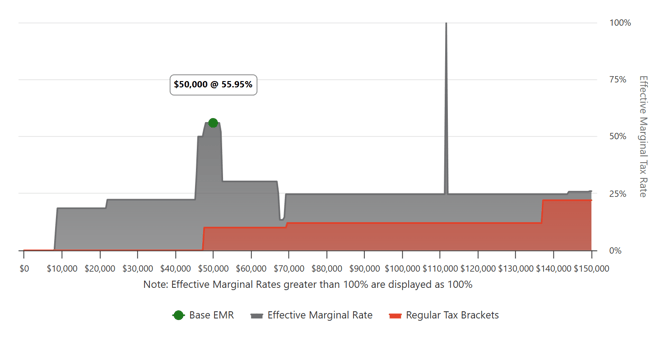
55.95% How did that happen?
| Impact of $1,000 IRA Withdrawal | Tax Rate | Additional Tax |
|---|---|---|
| $1000 IRA withdrawal | 12% | $120.00 |
| Causes $850 Social Security taxation | 12% | $102.00 |
| Causes $1850 Capital gains taxation | 15% | $277.50 |
| Phase-out $222 of Additional Senior Deduction | 12% | $26.64 |
| Pushes another $222 Capital gains into taxation | 15% | $33.30 |
| Total Tax Burden on $1000 IRA withdrawal | $559.44 |
The Details tab in Tax Clarity will also show this information in a Base Case vs Scenario output:
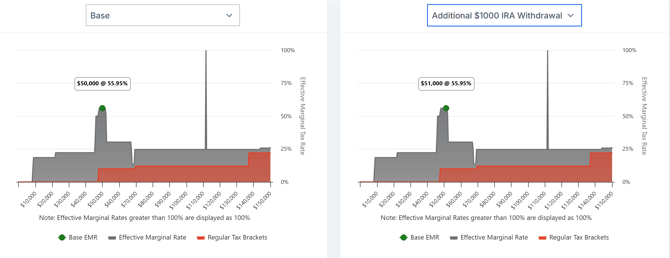
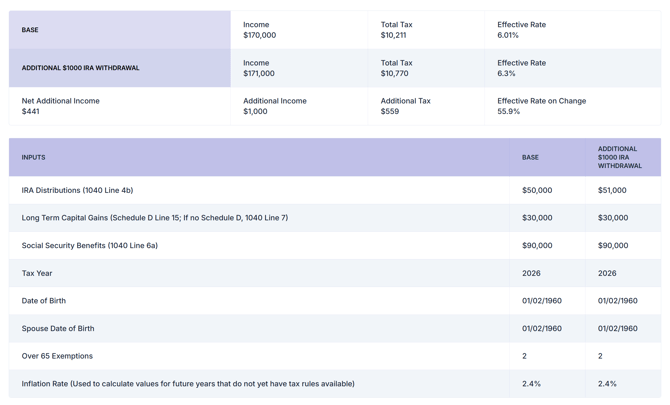
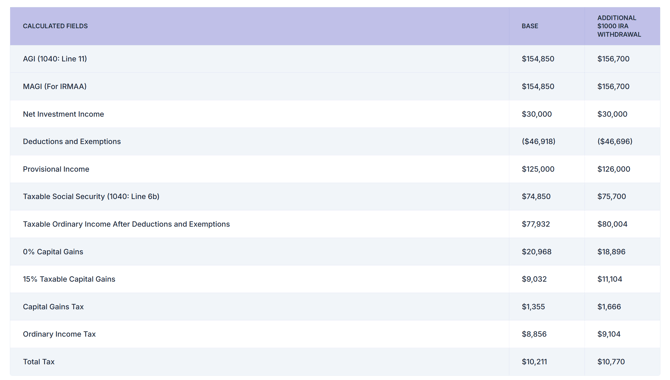
Based on the example above, there are several key items to review in the calculated fields. First, note that Adjusted Gross Income (AGI) increases by only $1,850. At the same time, deductions and exemptions are reduced by $222 due to the phase-out of the temporary senior deduction.
The total amount of capital gains shifted from the 0% bracket to the 15% bracket is $2,072. This consists of $1,850 of capital gains becoming taxable as a result of the $1,000 IRA withdrawal and the associated increase in taxable Social Security, plus an additional $222 of capital gains pushed into the 15% bracket due to the deduction phase-out.
AGI increases by only $1,850 because the capital-gain bracket shift and the loss of deductions affect taxable income, not AGI. These interactions create a disproportionate increase in taxes relative to the change in AGI—an example of the Tax Torpedo effect.